Physical Sciences
Geography 1000 Earth's Surface Environments
For this course, I used Google Earth to research real time and present day earthquakes and volcanoes around the world. I then gave a brief synopsis and description of each earthquake or volcanoe listed.
Earthquakes
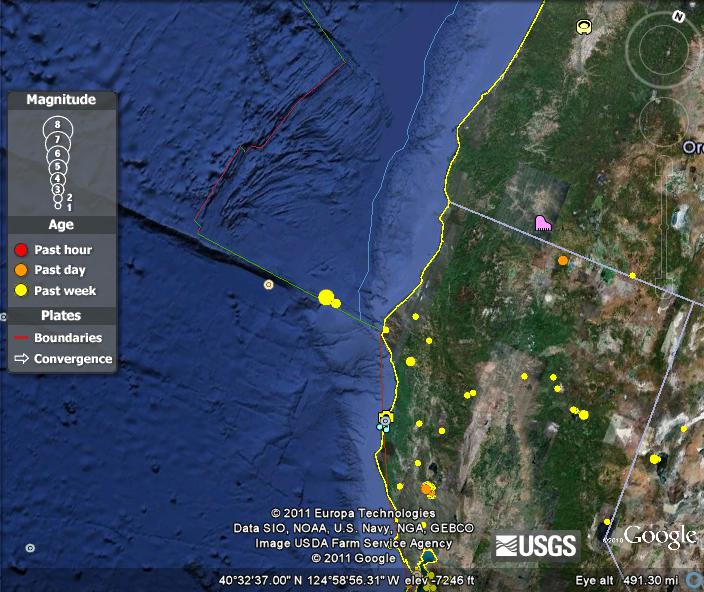
Earthquake 1
-
4.5 Magnitude Earthquake
-
Offshore Northern California, 57 Miles West of Petrolia, CA
-
Occurred on March 6th, 2011 at 5:46 AM at epicenter, focus at a depth of 24.7 km (15.3 miles)
-
Oceanic-Continental Plate Boundary
-
I believe this earthquake is cause due to subduction of the Pacific oceanic plate as it meets the N. American continental plate. The less dense Pacific plate submerges under the N. American plate, causing disturbances that may be responsible for this earthquake.
Earthquake 2
-
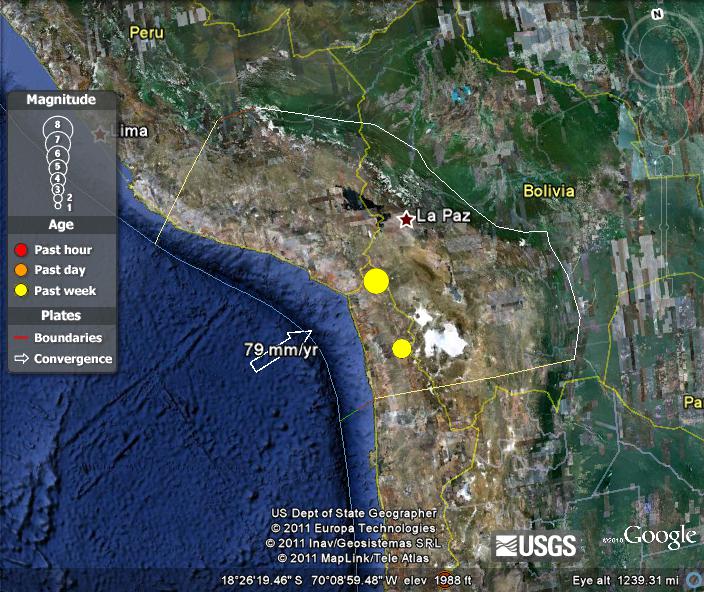
6.2 Magnitude Earthquake
-
18.115°S, 69.391°W, 57 miles east of Tacna, Peru
- Occurred March 6th, 2011 at 9:31 AM at epicenter, focus at depth of 101.3 km (62.9 miles)
- Earthquake occurs at oceanic-to-continental plate boundary
- I believe that this earthquake is caused by the subduction of the Nazca Plate subducting beneath the less dense South American Plate, causing faults to be responsible for this earthquake.
Earthquake 3
-
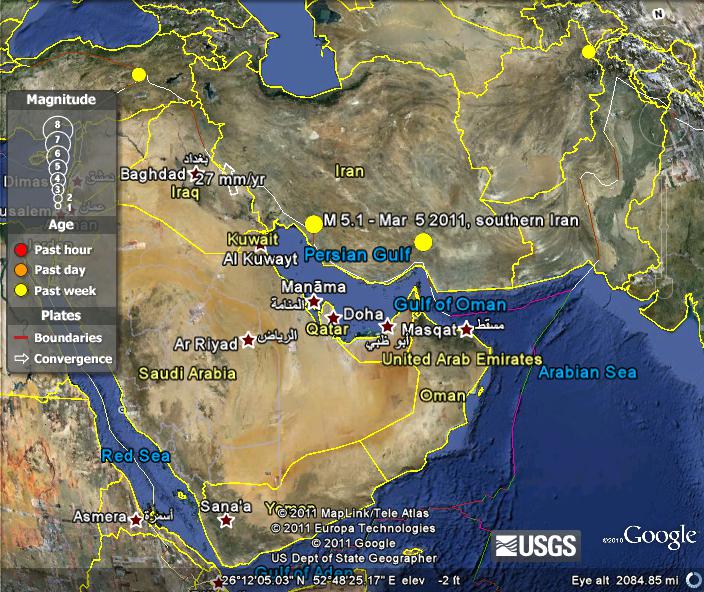
5.1 Magnitude Earthquake
-
Southern Iran, Epicenter 389 miles south of Tehran, Iran
- Occurred Saturday March 5, 2:54 PM at epicenter, focus at depth of 9.9 km (6.2 miles)
- Earthquake occurs along a continental-to-continental plate boundary.
- I believe this earthquake to be continental-to-continental because it appears to occur along the boundary between the Arabian and Iranian Plates. The plates seem to converge, which would cause either a normal or reverse fault, triggering an earthquake.
Earthquake 4
-
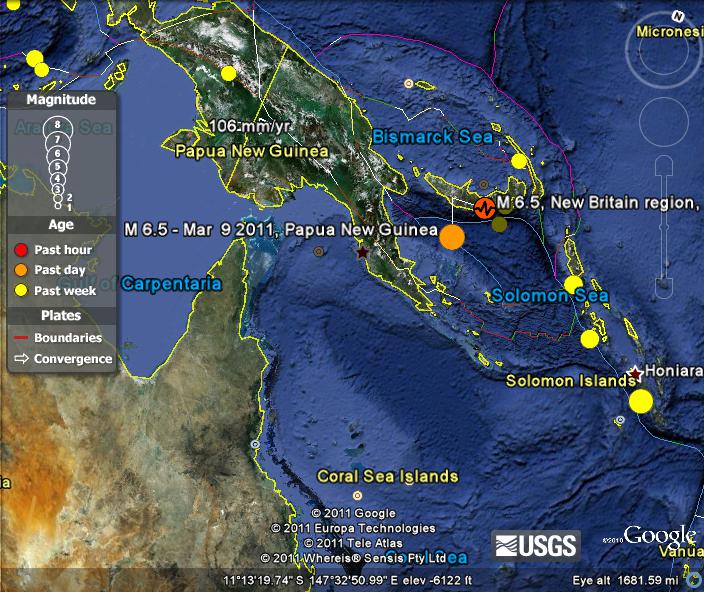
6.2 Magnitude Earthquake
-
Papua New Guinea, 14 Miles NNE of Kandrian, PNG
-
Occurred on March 10, 2011 at 7:24 at epicenter, focus at depth of 29 km (18 miles)
-
Earthquake occurs along oceanic-to-oceanic plate boundary
-
I believe this earthquake occurs along an oceanic-oceanic plate boundary due to the Indo-Australian Plate subducting underneath the Caroline Plate.
Earthquake 5
-
5.7 Magnitude Earthquake
-
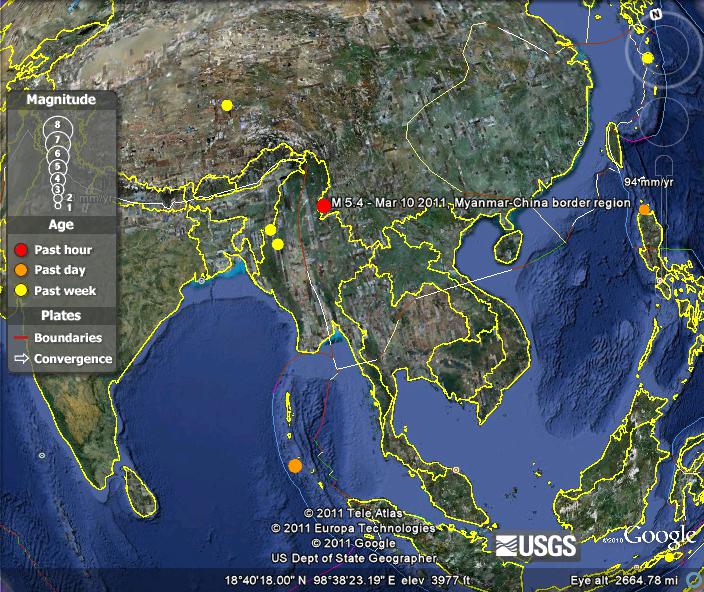
Myanmar China Region, 152 miles WSW of Dali, China
-
Occurred March 10, 2011 at 11:28 AM at epicenter, focus at depth of 34.9 km (21.7 miles)
-
Earthquake takes place near continental-to-continental boundary
-
I believe that this earthquake occurs along a continental-to-continental boundary because the Indo-Australian Plate is converging and subducting undre the Euralasian Plate. Causing earthquakes to occur.
Volcanoes
Volcano 1
-
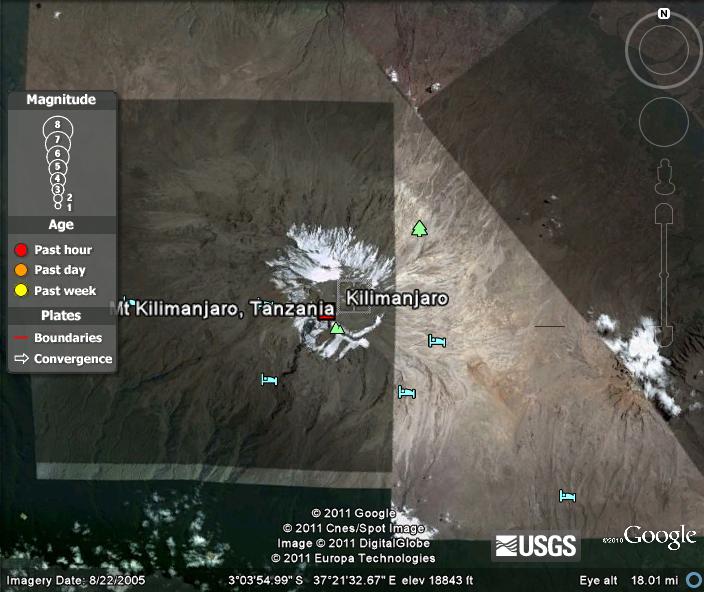
Kiliminjaro, Tanzania
-
Caldera Volcano
-
Volcano occurs along a divergent boundary within the African Plate
Volano 2
-
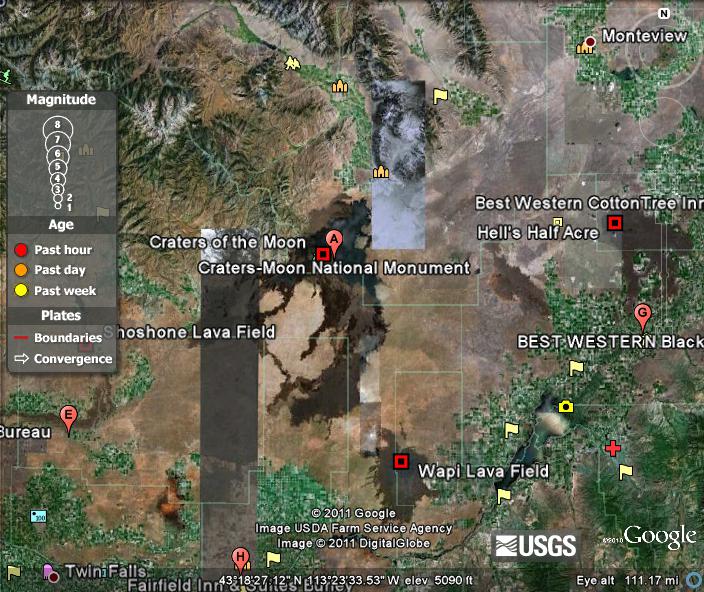
Craters of the Moon, Idaho
-
Cinder Cone Volcano
-
Volcanoes caused by hot spots beneath the N. American Plate
Volcano 3
-
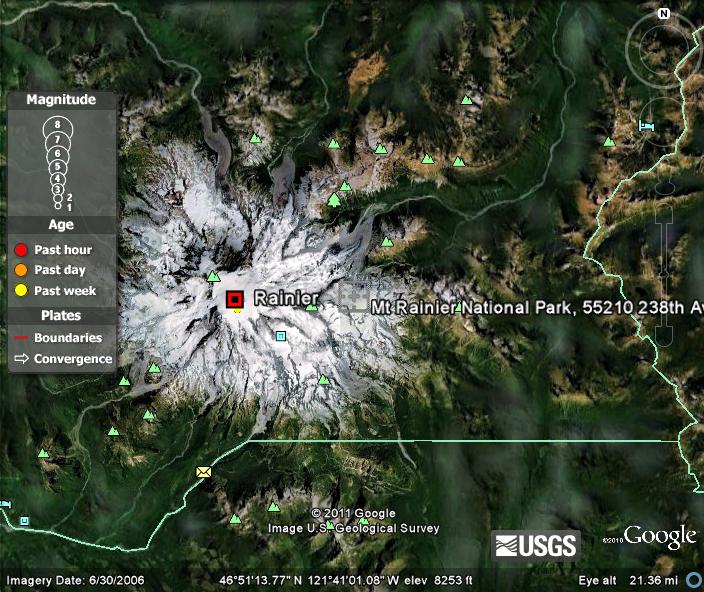
Mt. Rainier, Washington
-
Composite Volcano
-
Volcano occurs on oceanic-continental plate boundary between the Pacific and N. American plates
Volcano 4
-
Mauna Loa, Hawaii
-
Shield Volcano
-
This Shield Volcano occurs due to a hot spot over in the Pacific Plate

Reflection
1 - The correlation between earthquakes and volcanoes is extremely significant in relation to the Theory of Plate Tectonics. At the points where plates make contact, faults will slid in a normal, reverse, or horizontal behavior. This behavior is directly related to how larger oceanic and continental plates interact with one another. If a plate submerges under another in subduction zones, the upper plate may be pushed up some, causing faults to cause earthquakes. When they move horizontally past each other, faults may catch or lock, and when the pressure of the moving plates is enought to break this pressure, violent earthquakes may occur. Earthquake zones strongly correlate between the boundaries between plates, supporting the Plate Tectonics Theory.
The frequency of volcanoes along plate boundaries also supports Plate Tectonic Theory. When plates collide, the more dense plate subducts or submergres under the lense dense plate in subduction zones. The less dense plate will cause upwelling of the plate, allowing gases and magma from the Asthenosphere to rise the surface, creating volcanoes. Also, diverging plates create gaps in the lithosphere, allowing magma and other chemicals to rise as well, creating volcanoes as well and supporting the Plate Tectonic Theory.
2 - The spatial relationship and distribution of earthquakes and volcanoes on Earth is to an extent predictable. Areas of the globe which sit atop plate boundaries can expect to have a significantly higher amount of earthquakes and volcanic eruptions occur. With the distribution of volcanoes, look at the Ring of Fire in the Southwest Pacific Ocean and observe how many active volcanoes reside there. This is due to the multiple number of plates interacting with the Pacific Plate. One can expect that earthquakes and volcanic eruptions there can even be commonplace, and simply a factor in the local peoples' way of life.
The spatial relationship of volcanoes and earthquakes is more broad. Especially with volcanoes. A composite volcanoe that has a major eruption may erupt large amounts of ash and pyroclasts can be released into the atmosphere. These gases and ash in the atmosphere can block insolation, inciting a continental or even global climate change. Some scientific theories support that the Ice Age could have been started by a large volcanic eruption. The spatial relationship of volcanoes is continental, if not global.
3 - Before this course, I was unaware that earthquake zones were not only caused by faults, but by much larger continental and oceanic plate boundaries. These converging, diverging, and subducting plates and hot spots occur drive the constructive and destructive behavior of earthquakes and volcanoes. I was extremely interested in how Iceland is an evergrowing country due to the divergence of the Atlantic Ocean seabed.
Also, before this course, was not aware that earthquakes and volcanoes could be predicted. Although these predictions are not completely precise, scientists often have a relative knowledge of when some volcanoes or earthquakes will occur. Doing this project as well, I was unaware of how many large earthquakes happen every day, if not every hour. While researching earthquakes for the first part of this project, I found earthquakes of magnitude 6 and higher that had occurred just minutes before I included them in this ePortfolio.
4 - My worldview of natural disasters has changed somewhat. I now see that some people inevitably choose to habitate in areas that are extremely prone to natural disasters. Coastal California, Japan, Southern China, and many other regions that sit atop plate boundaries are in the path of natural disasters. Although predicton of some of these disasters can now help save lives, it seems that inevitable property damage and death is always on the horizon in these disaster prone areas.
Although, with the help of earthquake-proof buildings, tsunami warning systems, and other preventative devices some of these horrible consequences of living in some of these "disaster" zones are averted. The article provided by the USGS also states that because of volcanic eruptions, soil in these areas after time can become amazingly rich and fertile, as in areas such as Hawaii and Indonesia. My worldview of some of these regions in "disaster zones" has altered. I now can see the positive and negative aspects of living in these areas due to scientific advancements and predictions where previously I had only seen them as negative places to take up residence, due to their high likelihood to be struck by an earthquake.
